

In the Pathway to Success series, every journey begins with a turning point. For Duong Thuy Anh (Class 5A2), that turning point did not come from a victory, but from a missed opportunity—the “Student of the Month” title. That moment became a quiet wake-up call, marking the beginning of a completely new chapter in her learning journey.
When “lack of direction” becomes an invisible limit
In her early primary school years, Thuy Anh was a familiar image of a standout student: quick, receptive, and especially eager to learn. With her love for studying and strong ability to grasp new knowledge, she was often seen as a role model in class with many notable achievements—particularly in Vietnamese Language. Thuy Anh was always full of ideas, surprising others with her rich imagination and strong emotional expression.
However, by Grade 5, as the demands of each assignment became more challenging, she began to realize that what she had been doing was no longer enough. It was at that moment that her “learning by inspiration” approach started to reveal its limitations.
In one Vietnamese Language class, Thuy Anh received feedback from Ms. Cao Thuc Uyen that was unusually direct—perhaps even a bit strict. It was not the familiar praise, nor was it a piece of writing recognized as outstanding as she had expected. In fact, this assignment caused her to miss the “Student of the Month” title.
What stayed with her was not the result itself, but one sentence from her teacher: “You could have done much better.” It was not a harsh remark, but it was enough to leave the young student silent for a long time. The opportunity to become “Student of the Month” slipped away—not because she lacked ability, but because she had not yet learned in a way that allowed her to fully realize her potential.
The feeling was not exactly sadness, but more like a moment of awakening—enough to make her pause and start thinking differently. And from that point on, a change began—slowly, but surely.
When learning is no longer “inspired,” but intentional
After that lesson, what mattered most was not pressure, but guidance. Her teacher did not simply point out shortcomings but patiently walked her through each step: how to develop ideas fully, how to organize them logically, and how to focus on depth instead of trying to include too many ideas at once.
More importantly, Thuy Anh began to learn in a completely different way. Instead of just trying to “finish the task” or writing based on inspiration, she was guided to analyze the prompt before writing, identify main and supporting ideas, structure her work clearly, and review her writing after completing it. Each piece of writing was no longer just an assignment, but a process of training her thinking and organizing her ideas.
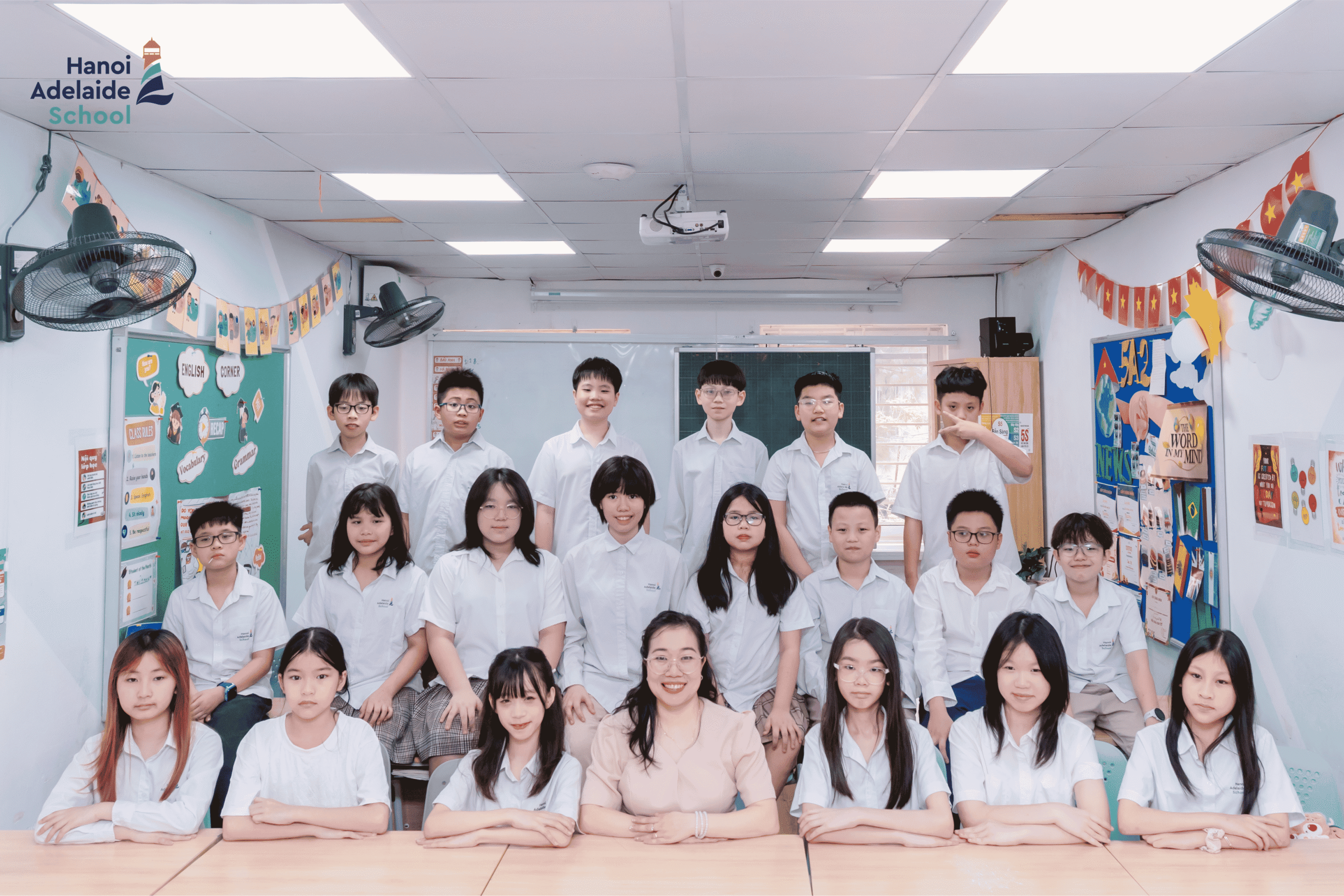
Thuy Anh’s transformation began with very small changes. She practiced writing more concisely, selecting key ideas before expanding them into details. She learned to view each lesson as a whole, rather than as disconnected parts. For recurring mistakes, she kept personal notes to remind herself in future assignments. Gradually, she built a more structured study routine: breaking goals into weekly targets and prioritizing weaker areas instead of focusing only on what she already enjoyed or did well.
At first, the change was not easy. “There were assignments I had to revise many times. Sometimes I spent more time than before, but the results still didn’t meet my expectations,” Thuy Anh shared.
This transformation was further tested when she stepped into larger academic arenas such as the World Scholar’s Cup (WSC). There were periods when she had to prepare for final exams while simultaneously getting ready for important competition rounds. Afternoons after school were followed by practice sessions; evenings continued with debating, research, and presentation practice.
At this point, her strategic approach to learning began to show clear results. She no longer studied in bursts of inspiration, but instead planned each day intentionally: allocating time based on priorities, setting small goals for each study session, and reviewing her progress weekly. At times, she had to set aside her favorite books or familiar moments of relaxation just to keep up with her daily targets.
“There were moments when I felt quite pressured trying to balance schoolwork and external competitions. But it was also during those times that I learned how to manage my time better, so I wouldn’t feel overwhelmed or discouraged,” she reflected.
It was then that Thuy Anh was no longer just learning academic content—she was learning how to grow. She began to manage her time, regulate her emotions, and understand that achievement does not come from fleeting inspiration, but from the consistency of a well-structured process built day by day.
Results that followed the change in learning approach
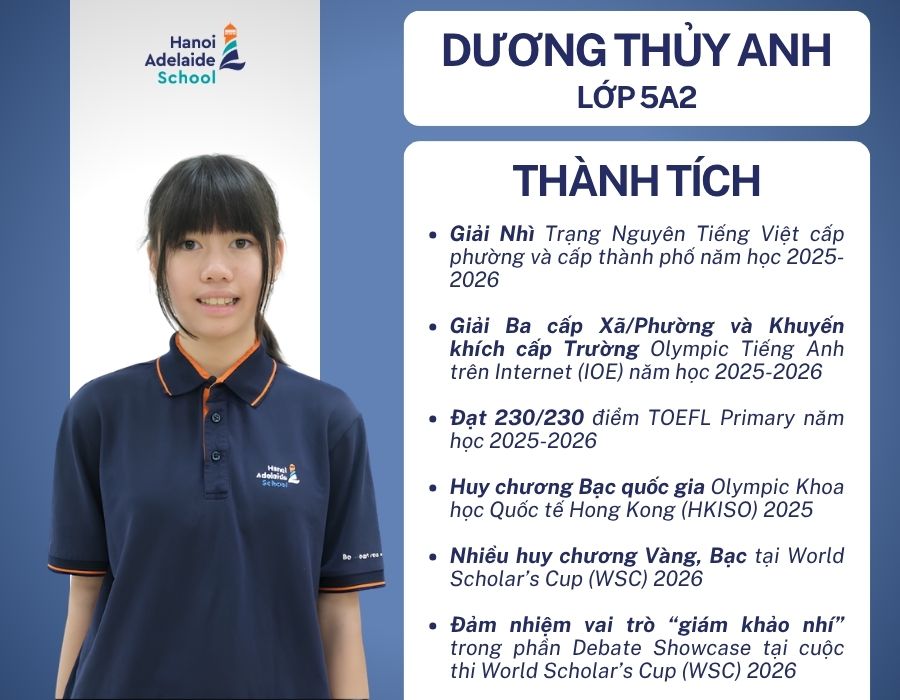
After this journey of transformation, Thuy Anh gradually made her mark across various academic platforms, both nationally and internationally:
• Second Prize – Trang Nguyen Vietnamese Competition (Ward and City Levels), Academic Year 2025–2026
• Third Prize and Consolation Prize – Internet Olympiad of English (IOE), Academic Year 2025–2026
• Achieved a perfect score of 230/230 – TOEFL Primary, Academic Year 2025–2026
• National Silver Medal – Hong Kong International Science Olympiad (HKISO) 2025
• Multiple Gold and Silver Medals – World Scholar’s Cup (WSC) 2026
• Selected as a “Junior Judge” for the Debate Showcase at the World Scholar’s Cup (WSC) 2026
These achievements are no longer the result of simply “being a good student.” They are the outcome of a shift in learning mindset—from studying based on inspiration to studying with strategy, clear goals, and persistence.
When asked what contributed most to her progress, Thuy Anh did not mention pressure or targets. Instead, she spoke about the feeling of learning proactively.
At Hanoi Adelaide School, learning extends far beyond the classroom into a wide range of experiences. Students are encouraged to try, to make mistakes, to improve—and most importantly, to grow with continuous support from their teachers. With this guidance, Thuy Anh gradually developed essential skills that form the foundation for her future growth.
If her journey could be captured in a single image, it might be this: one door quietly closing, only to open many larger ones ahead. From a girl who once learned by inspiration, she has become a student who knows how to plan, prioritize, and stay committed to her goals.
A missed opportunity did not bring her journey to a halt. On the contrary, it became the very moment that led her into a path where she no longer misses the opportunities meant for her.
Hanoi Adelaide School
Pioneering Competency-Based Education in Vietnam