

“I could have done better.” That was the thought lingering in Dao Vi Khoi’s mind (Class 7A1) after an international Math competition in Grade 6. During the exam, Khoi found himself drawn into the more challenging questions. The deeper he thought, the more time he spent on those difficult parts. By the time he glanced at the clock, several easier questions were still left unanswered, while time was almost up.
Walking out of the exam room, what left him with a sense of regret was not the difficulty of the test, but the feeling that he had missed out on points that were entirely within his reach. “I realized the problem wasn’t my knowledge. I knew how to solve many of the questions, but I didn’t know how to manage my time effectively,” Khoi shared. That one moment of “losing the rhythm” became a turning point in his learning journey.
When learning once stopped at “just enough”
Few people know that before achieving his current outstanding results, Vi Khoi was once a fairly average student. In primary school, his academic performance was generally stable—enough to keep up with the curriculum, but not enough to stand out. Studying was consistent, yet mostly about completing requirements rather than striving toward specific goals.
Everything began to change when Khoi entered lower secondary school. The new academic environment, with its higher expectations, prompted him to take his learning more seriously. Instead of studying out of habit, Khoi started setting clear goals, creating a study schedule for each subject, and dedicating more time to practice.
These initial changes were quiet, but step by step, they led to a clear improvement in his academic performance.

Sometimes, the greatest pressure doesn’t come from the exam itself
As his academic performance began to improve, Khoi faced another challenge. It wasn’t difficult problems, but the pressure inside the exam room. There were times when, despite thorough preparation, he found himself overwhelmed by constant thoughts about the results and the need to perform well. This anxiety led him to overthink, affecting his ability to fully demonstrate his true capabilities.
“No matter how well I prepare, if my mindset isn’t stable, my performance may still fall short of expectations,” Khoi shared. These experiences helped him realize that learning is not only about accumulating knowledge, but also about learning how to stay in control during critical moments.

After the disappointing international Math exam, Khoi decided to adjust his approach. Instead of spending too much time on difficult questions, he focused on completing the ones he was confident about first. Only then would he return to tackle more challenging problems.
It may sound simple, but for Khoi, this marked a significant shift in mindset. Rather than trying to handle everything at once, he learned to identify what mattered most at each moment. “I realized that sometimes having the right strategy is just as important as knowing the solution.”
When the method changes, the results change
From that point on, Khoi’s learning became more structured. He built a step-by-step study pathway: mastering foundational knowledge, understanding the core concepts, and only then moving on to advanced problem types. Key content was practiced repeatedly to develop strong reflexes, instead of studying in a scattered way. At the same time, Khoi maintained a balance between study and rest to stay mentally stable ahead of exams.
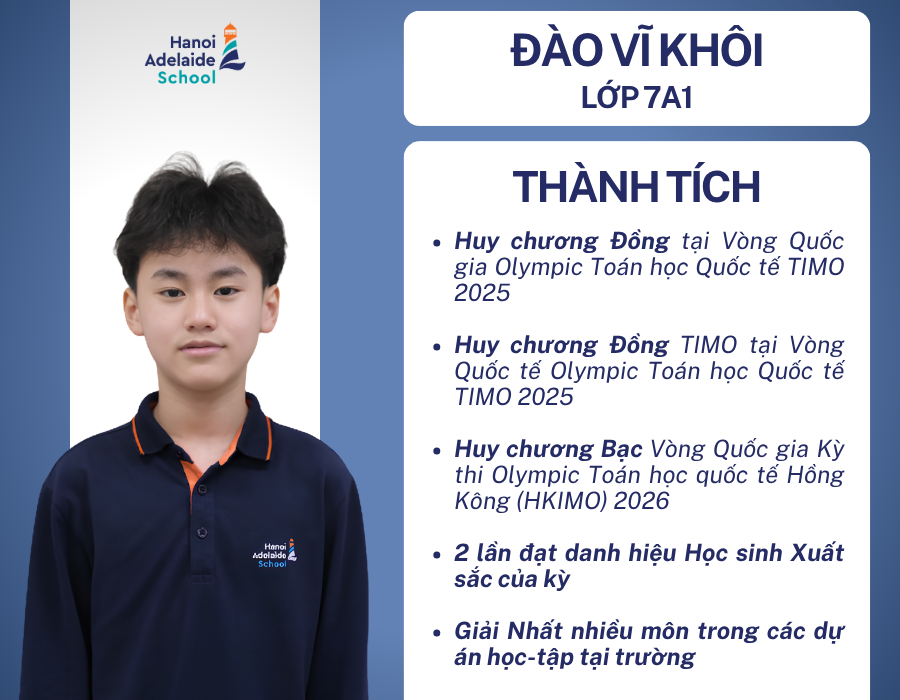
When the learning method is right, studying no longer feels like prolonged pressure, but becomes a process that can be managed. And that shift gradually brought about clear results:
- Bronze Medal – National Round, TIMO International Mathematics Olympiad 2025
- Bronze Medal – International Round, TIMO International Mathematics Olympiad 2025
- Silver Medal – National Round, Hong Kong International Mathematical Olympiad 2026
- Twice awarded “Excellent Student of the Term”
- First Prize in multiple school academic projects
Looking back on his journey, Khoi believes that the most valuable thing he has gained is not the medals or the list of achievements. More importantly, he has come to understand what he needs to do to improve, when to push forward, and when to adjust. “Some opportunities only come once. If you are not well-prepared or don’t have the right strategy, it’s easy to miss them,” Khoi shared.
For this 7A1 student, the biggest lesson from that moment of “losing the rhythm” was not about any specific type of problem or formula—it was about proactiveness. Because sometimes, to go further, what matters is not studying more, but knowing how to seize the opportunities already within your reach.
Pioneering Competency-Based Education in Vietnam