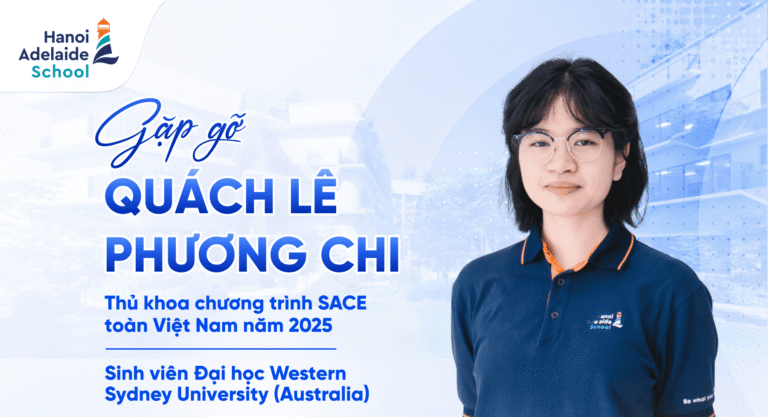


When people mention Quach Le Phuong Chi (12I), many immediately think of her title as the Valedictorian of the SACE Class of 2025 at Hanoi Adelaide School. Yet before achieving this remarkable result, Chi had already been on a parallel journey: balancing an intensive academic workload while serving as a mentor to younger students.
What makes her story particularly meaningful is that she began mentoring while she herself was still navigating the demanding final year of the program. It was not a decision made after everything had settled, but a choice to step forward in the middle of the busiest and most challenging period.
From moments of struggle to the desire to support others
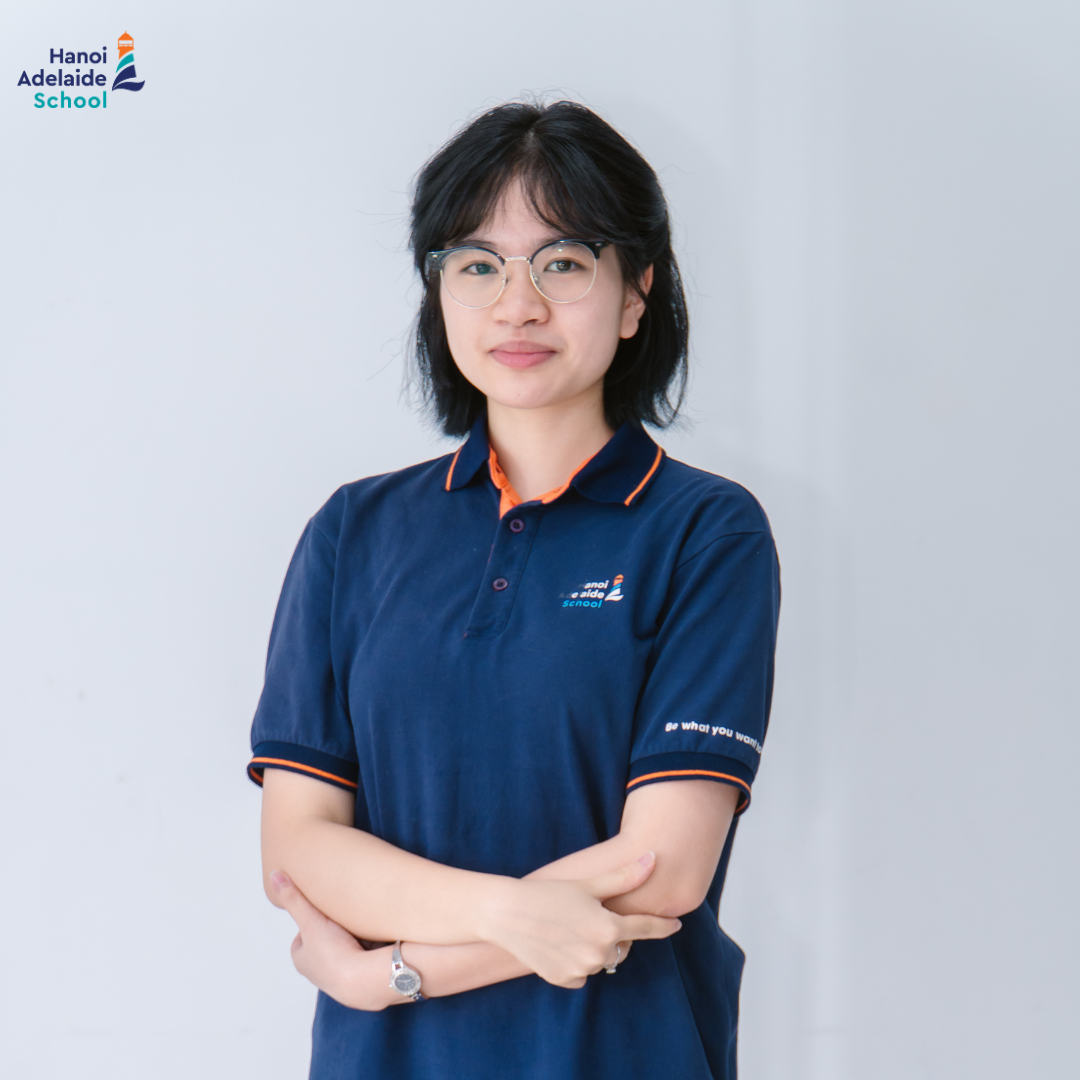
Few people know that during the first half year of studying SACE, Phuong Chi went through a rather difficult period. The learning approach was completely new, the assignment requirements were very different, and she had to manage two parallel high school curricula — the Vietnamese and Australian programs.
“At the beginning, I felt quite overwhelmed because the way assignments were structured in the program was very different from what I had experienced before,” Chi shared.
That experience helped her deeply understand the feelings of first-year SACE students. Therefore, when the opportunity came to become a mentor for Business Innovation and Media Studies, Chi did not see it simply as an extracurricular activity. Instead, she saw it as a way to ensure that younger students would not have to face those early challenges alone.
For every mentoring session, Chi prepared very carefully. Before meeting with the students, she would read their work in advance, note areas that could be improved, and think about ways to help them develop their ideas more deeply. Rather than just correcting mistakes, she focused on helping students understand the core issues: why an argument might not yet be convincing, why the structure might feel unclear, and how the writing could be strengthened.
With this support, students gradually gained a clearer understanding of the project requirements and assessment criteria. Chi also helped them see their ideas more clearly and guided them on how to effectively develop those ideas within each assignment.
Her mentorship did not stop at the beginning of a project. Phuong Chi continued accompanying students throughout the process of developing and revising their work. She pointed out specific areas that could be improved to achieve higher scores. As a result, many students felt a strong sense of encouragement and support during what is often the most stressful stage of their learning journey.
When guiding others also helps you learn better

Through the process of accompanying and analyzing students’ work, Phuong Chi gradually grew in her own learning approach. Whenever she had to explain why an argument was not yet strong enough or why a piece of evidence was not fully convincing, she had to reorganize her own knowledge in a more structured and logical way.
Instead of studying each topic in isolation, Chi began to see every subject as a complete system with clear structures, criteria, and standards. Regularly comparing students’ work with the official assessment rubrics also helped her better understand what each subject truly required — not only how to “do it correctly,” but what it means to do it well and even do it exceptionally.
At the same time, the constant process of analyzing and giving feedback strengthened her critical thinking. She learned to ask deeper questions, identify weaknesses in an argument, and suggest specific ways to improve it. To successfully balance both mentoring and her own studies, Chi also developed stronger time management and self-discipline, organizing her schedule carefully to meet the demands of both roles.
These quiet but consistent changes gradually built the foundation that allowed her to step confidently into her final year — and ultimately achieve the title of Valedictorian.
Success is more than just scores
Hanoi Adelaide School
Pioneering Competency-Based Education in Vietnam