

Nguyen Dieu Anh (12S1): “You only truly understand what you’ve learned when you teach it to someone else…”
At Hanoi Adelaide School, especially in the Vietnam–Australia High School Dual Program, learning does not happen only between students and teachers. Students are also supported by those who have walked the path before them—from senior students acting as mentors to teachers serving as academic advisors.
The mentor model at H.A.S is designed with a clear goal: to help students understand lessons more deeply, approach assignments in the right direction, and avoid feeling “lost” in a highly academic learning journey.
As a Grade 12S1 student currently participating in the Creative Arts Mentor Program, Dieu Anh was once a mentee herself during her early years in the SACE program. For her, the greatest value of this model is the feeling that no one learns alone.
Student mentors – the advantage of someone who has “been there before”

According to Dieu Anh, support from senior students provides not only knowledge but also real study experience. Even before becoming a mentor, she already had a clear learning method: if you truly want to understand a topic, try teaching it to someone else. Once she officially became a mentor and began guiding younger students, this method became more practical than ever.
“For me, whether I truly understand a topic shows clearly in how I explain it,” she shared. “When I started teaching and guiding others, I realized I had to understand the lessons more deeply and clearly to make them easy for others to grasp.”
Through mentoring, Dieu Anh regularly reviews content, revisits assessment requirements, and finds ways to explain concepts more simply to younger students. This process has strengthened her own understanding and greatly supported her personal academic work.
Mentor Program – support at the right time, in the right way
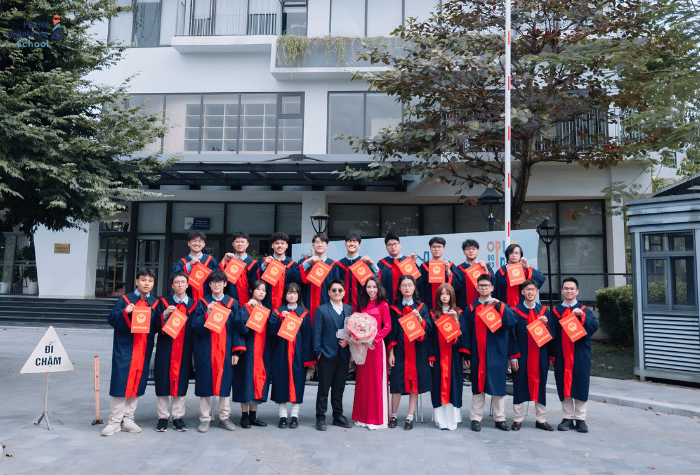
Within the SACE program, the Mentor Program is designed as a structured academic support system. Mentors do not complete assignments for others; instead, they provide direction—helping students understand requirements, suggest approaches, build outlines, and develop ideas.
“Being a mentor has helped me a lot in my own assignments,” Dieu Anh said. “Not only because I understand the content better, but because I’ve learned to think in a more structured and logical way.”
From her experience, she believes H.A.S students gain three key benefits:
-
Deeper understanding, not surface learning: Students learn why they do things, not just how to finish tasks.
-
Greater confidence in thinking and presenting ideas: A safe space for discussion and feedback builds strong academic thinking.
-
A sense of support and companionship: Students know someone is always ready to listen and help when challenges arise.
Vietnam–Australia Dual Program: A place where students grow
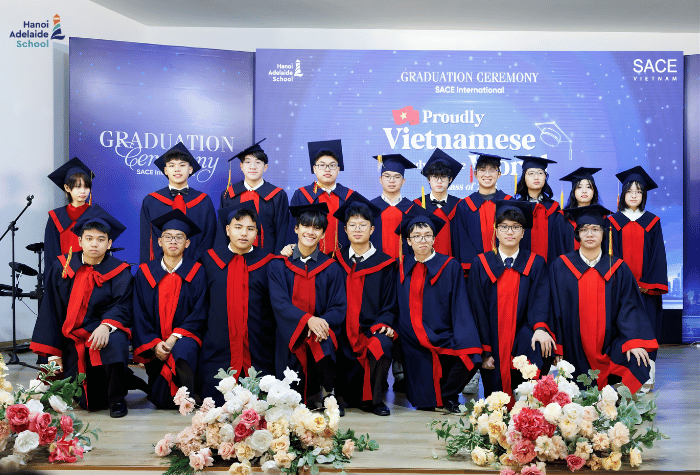
Dieu Anh’s story shows that the Mentor Program at H.A.S not only helps students achieve better academic results but also builds a positive learning community—where students learn to share, support one another, and take responsibility for collective progress.
Through the SACE program, students develop Australian-standard academic thinking at the high school level via projects and assessments requiring analysis, creativity, and critical thinking. At the same time, initiatives like the Mentor Program help students strengthen soft skills, leadership, and a spirit of collaboration.
The fact that students can excel academically while becoming mentors for younger peers reflects a learning environment where progress is measured not only by grades but also by growth, responsibility, and readiness to support others.
Hanoi Adelaide School
Pioneering Competency-Based Education in Vietnam