

In the Vietnam–Australia Dual Diploma Program (SACE) at Hanoi Adelaide School, the Mentor Program is more than simply a student-supporting-student model. It is a space where those who have already gone through the challenges choose to return and support younger students, offering guidance through their own real experiences.


According to The Anh, what a mentor offers first is not the answer, but the method.
His mentoring philosophy is very clear: not to give ready-made answers, but to guide others in finding their own answers. Each mentoring session often begins with carefully reading the assignment brief — a fundamental step that determines the entire direction of the work. From there, he helps students analyze the task, identify the key focus, and build an appropriate structure.
For reports or essays, The Anh shares basic writing structures as a kind of “framework” for students to develop their ideas.
“Structure is only the foundation. The most important part is still the students’ own thinking and perspectives,” he explains.
With the support of mentors, students are able to:
-
Clearly understand the requirements of their projects from the beginning
-
Learn how to manage time and organize their work systematically
-
Feel more confident expressing their own viewpoints
-
Reduce pressure throughout the learning process
More importantly, they gradually develop proactive learning habits. Once they understand the method, students can independently interpret tasks, build their own outlines, and manage their progress — core competencies in the SACE program.
When the mentor also grows through the journey
The mentoring experience does not only benefit the students being supported. For The Anh, it has also been a meaningful journey of personal growth.
To explain complex concepts in simple language, he must first understand them deeply. By putting himself in the listener’s position, he learns to adjust his explanations, choose clearer examples, and present ideas more logically. As a result, his communication and explanation skills develop naturally through each mentoring session.
Another important benefit is the ability to organize and systematize knowledge. Each time he prepares for a mentoring session, The Anh reviews the assignment requirements, revisits the structure, and considers the most effective way to guide students. This process strengthens his understanding while allowing him to look at the material from different perspectives.
Perhaps the most meaningful change lies in a growing sense of responsibility. When listening to the concerns of younger students, he realizes that his focus is no longer only on personal goals. The progress of others has also become a source of motivation and fulfillment for him. This shared journey creates a positive bond within the learning community.
Mentor Program – when progress becomes a shared effort
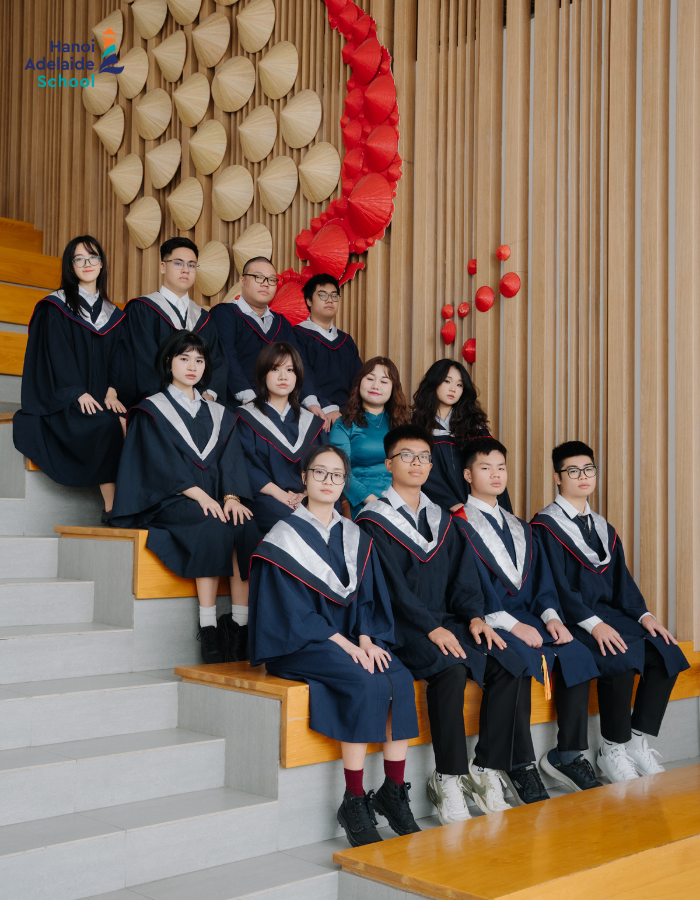
In the Vietnam–Australia High School Dual Diploma Program at Hanoi Adelaide School, students are not only trained in academic thinking aligned with Australian standards, but are also supported by a comprehensive learning ecosystem that includes teachers, academic advisors, and the Mentor Program.
Mentors do not replace the role of teachers. Instead, they complement it by offering the perspective of someone who has already experienced the same journey. This combination ensures that students receive both professional academic guidance and a sense of psychological support and practical insight.
The story of Nguyen The Anh highlights the deeper value of the Mentor Program. When a student who once faced challenges chooses to return and support others, the learning community becomes stronger and more sustainable. Progress is no longer an individual achievement, but a shared effort.
Sometimes, what helps students feel more confident is not having the answer readily available, but having someone show them how to find the answer. And when students can move forward confidently on their own learning journey, that is when the Mentor Program truly fulfills its mission — nurturing students who are not only more capable, but also willing to support and lead others.
Hanoi Adelaide School
Pioneering Competency-Based Education in Vietnam